

How to Change the Order of Loading Using Priority Groups
Priority groups were originally designed to manage different unloading destinations along the way of a truck or trailer. However, they can also be useful if you need to enforce a different order of loading of cargo items for some reason. By defaults, the order of loading is defined by the size of items: the largest boxes are loaded first. This setting shall enable the most efficient usage of cargo spaces, however, in some cases this might not be the desired solution. One of the options on how to change the settings is by applying the priority groups.
(Priority) Groups enable you to decide in which order the items will be loaded into the cargo space. Items in Group 1 will be loaded first, followed by the second group, then comes the third group, etc. You can, therefore, influence the load plan, e.g., depending on the order in which the final destinations will be visited by the truck.
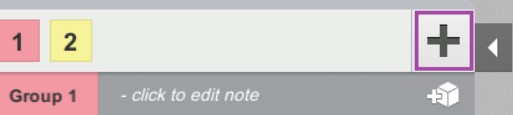
More groups can be added by clicking on the + icon:
This is what using Groups looks like in the Load plan:


As you can see from the pictures above, there are 2 palettes of colors. One is for the items, and the other one, with pastel colors, is for Group. Depending on whether you click on an item or on a group in the input list on the left-hand side column, EasyCargo will show you colors either on the item or on the group level.
You can use the Drag & Drop function to move items within one priority group (without changing the loading calculation algorithm) or between priority groups according to your needs.
It is also possible to move entire groups, whereby the system automatically updates the numbering while sustaining a consistent coloring of the labels during transfers.
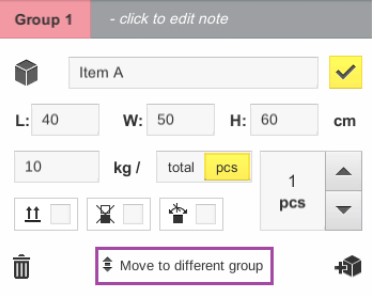
You can also move items from one group to another using the button Move to different group:
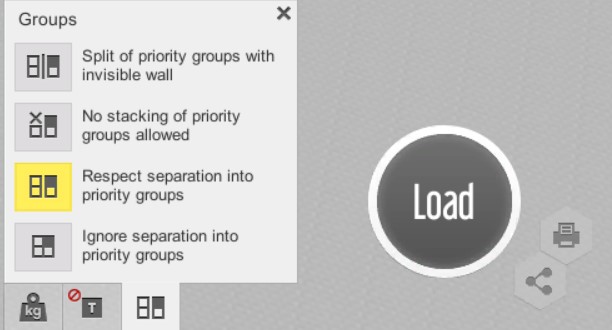
In the bottom part of the screen you can find more settings related to Priority Groups:
you can respect/ignore separation in priority groups, disable the stacking of items in one group on top of items in another group, or even split priority groups by an invisible wall, as shown here:
Note: When deleting a group, the items in the given group will also be deleted!
You can find step-by-step instructions for using Groups in our tutorial video too.
Here are the advanced settings.
Tip: Some companies also use groups for individual customers, whereby they ignore separation of items into priority groups then but have a better-structured load plan.
Please note that EasyCargo primarily stacks the items up heightwise in order to use as little floor space of the cargo space as possible. To prevent this, you can either set the items as non-stackable (settings on item type level), adjust the load plan manually, or divide the items into groups, and disable the stacking of groups.